
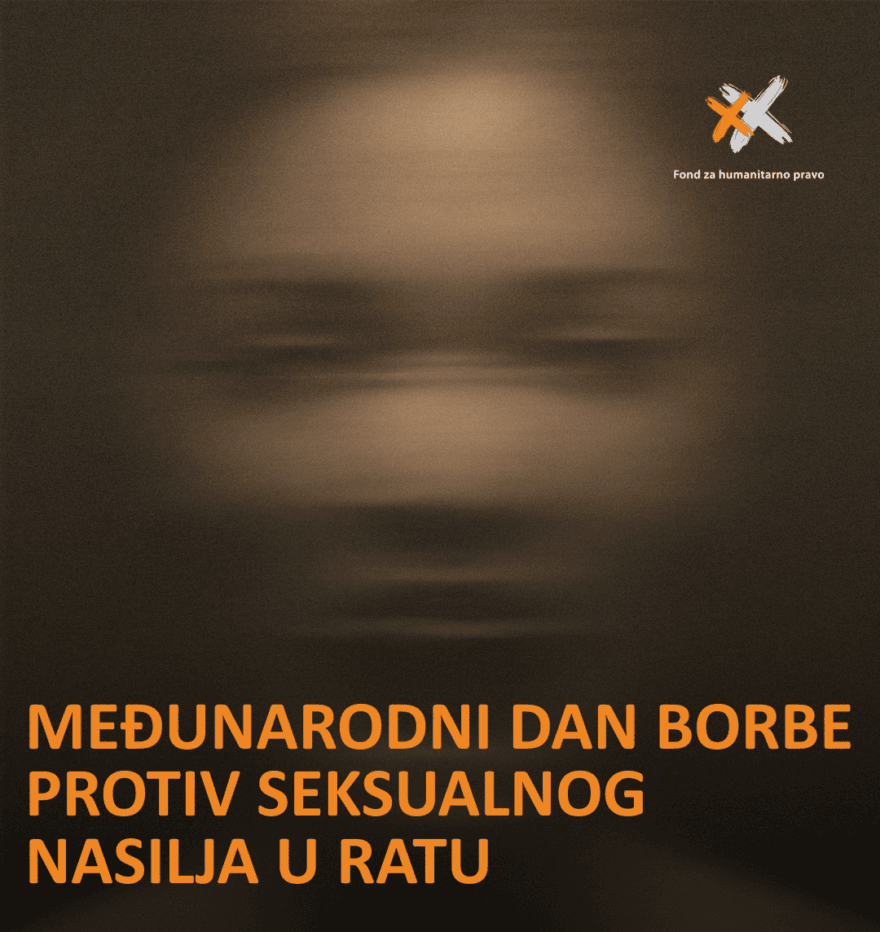
 On the occasion of the International Day for the Elimination of Sexual Violence in Conflict, observed on June 19, the Humanitarian Law Center points out that the prosecution of sexual violence committed during the armed conflicts in the former Yugoslavia before Serbian courts remains extremely limited and disproportionate to the prevalence and gravity of these crimes.
During the armed conflicts in the former Yugoslavia, sexual violence was systematically used as a means of intimidating civilian populations and establishing control over territories. The exact number of victims has never been determined, but estimates range from at least 20,000 to many tens of thousands of women who survived rape and other forms of sexual violence.
In 2015, the United Nations General Assembly proclaimed June 19 as the International Day for the Elimination of Sexual Violence in Conflict, commemorating the adoption of UN Security Council Resolution 1820 on June 19, 2008. This resolution affirmed that rape and other forms of sexual violence may constitute war crimes, crimes against humanity, or acts of genocide, and imposed an obligation on states to prosecute those responsible and ensure victims’ access to justice.
Despite this, wartime sexual violence remains outside the priorities of the domestic judiciary. During the 23 years of operation of the War Crimes Prosecutor’s Office, only 13 indictments have been filed against 29 individuals for criminal offenses involving sexual violence, representing just 11% of all indictments. By comparison, 48% of all defendants before the International Criminal Tribunal for the former Yugoslavia (ICTY) were also charged with sexual violence. Furthermore, only five indictments related exclusively to wartime sexual violence – in the cases of Brčko, Kalinovik, Bratunac II, Goražde, and Vukovar-Proleterska.
Although the revised Prosecutorial Strategy for the Prosecution of War Crimes (2022–2026) identifies sexual violence as a priority, these five indictments were filed between 2018 and 2023, when the previous Prosecutorial Strategy had already envisaged intensified work on such cases. Since the filing of the indictment in the Vukovar-Proleterska case in 2023, no new indictments for sexual violence have been brought.
An additional problem is the inadequate legal qualification of these acts. In several cases, acts of sexual violence were treated as inhuman treatment or were entirely disregarded as independent forms of war crimes, despite international standards for prosecuting conflict-related sexual violence.
Before Serbian courts, 11 proceedings involving wartime sexual violence have been concluded with final judgments. The Vukovar-Proleterska case, in which Jovan Radan was sentenced in the first instance to seven years’ imprisonment for rape committed in Vukovar in 1991, is currently pending appeal before the Belgrade Court of Appeals. In the Ćuška/Qushk case, following the death of the accused Srećko Popović, the rape charge was removed from the indictment. Of the 11 final judgments, eight were convictions, resulting in the final conviction of 12 individuals. By contrast, three acquittals resulted in the final acquittal of 13 individuals. Given the scale of sexual violence during the wars in the former Yugoslavia, such statistics are devastating.
Particular concern is raised by the sentencing policy of domestic courts. In cases dealing exclusively with sexual violence, prison sentences ranging from five to eight years were imposed. Courts considered the passage of time and the family circumstances of the accused as mitigating factors, while the gravity of the crimes and the consequences of sexual violence for victims were not always adequately valued. Considering that these are among the gravest forms of violence committed during wartime, such sentencing practices diminish the seriousness of the crimes and send a message that may further discourage victims from reporting the violence they endured.
Another issue is the fact that no injured party in proceedings concerning sexual violence has been awarded compensation within the criminal proceedings. Courts refer victims to civil litigation to seek damages, thereby delaying the realization of their rights, creating additional costs, and increasing the risk of retraumatization, as they must also forgo protective measures.
In light of the above, the Humanitarian Law Center calls on the War Crimes Prosecutor’s Office to intensify investigations and prosecutions of wartime sexual violence, applying international standards and ICTY practice, and urges courts to impose sentences proportionate to the gravity of the crimes and to decide on compensation claims within criminal proceedings. More than two decades after the establishment of specialized war crimes judicial institutions, the results achieved in prosecuting sexual violence do not represent justice, nor do they indicate a systematic and continuous approach to resolving such cases. Rather, they reflect the extent of impunity that still persists.